
How to Check Criminal History in Durham
Begin with the office that made the Durham record. A Durham Police incident starts with DPD, a detention entry starts with the Durham County Sheriff, and a criminal case belongs to the state-operated clerk. No single Durham database merges those products. A careful self-review moves from the newest Durham city facts toward the court disposition and, when identity must be certain, to a fingerprint-supported state record.
- Identify whether Durham Police, the sheriff, or a campus agency handled the event.
- Request the public incident or arrest facts from that Durham agency, using the report number, date, place, and involved person when known.
- Check the official Durham inmate list if the arrest is recent and custody is the immediate question.
- Search North Carolina eCourts by name or docket, with Durham selected as the location, then confirm the file with the clerk.
- For your own statewide history, use the North Carolina SBI fingerprint-based Right to Review rather than a broad name match.
The broader Durham County criminal history overview explains county and state channels in more depth. Durham searches should remain tied to the agency and filing location shown on the record.
Durham Police Records Portal
The City of Durham public-records portal is the formal route for DPD administrative and releasable report material. Durham does not accept these requests by phone. The Durham portal tells requesters to search prior releases first, then submit one clear request. Staff aim to respond within 14 days, though a large request or one needing legal review can take longer. That is a Durham service goal, not a statewide production deadline.
| Portal field | What to enter |
|---|---|
| Contact details | Name, email, daytime phone, and mailing address when needed |
| Record description | A precise account of the report or public fact sought |
| Title and date | Known report title, incident date, or a narrow date range |
| Delivery choice | Inspection, photocopy, or electronic copy |
Most Durham records are free to inspect, while media, copies, or unusually extensive retrieval can lead to actual-cost charges disclosed in advance. Submit the Durham request once. Duplicate requests can slow the City’s effort to locate the same Durham record.
If inspection will meet the need, state that preference. Durham staff may arrange an appointment rather than produce a new copy. General portal questions go to Communications, while accessibility help is available through the City ADA Coordinator and Relay 711. Those support contacts help with the Durham request process, but DPD remains the record custodian for police material.
The Durham Police Department
The Durham Police Department creates reports for incidents it investigates within city jurisdiction. Its report-copy channel asks for useful identifiers such as an incident or offense report number, event date, location, involved person, and desired format. DPD does not hold the court judgment or the sheriff’s booking file, so a police response should not be treated as a full Durham criminal history.
The official Durham Police profile gives useful context for the Durham records custodian.
That Durham source identifies DPD as the correct first stop for Durham police reports, before a search moves to county custody or court records.
Duke University Police and North Carolina Central University Police are separate report creators. An event on campus should begin with the campus department that responded, even when the address says Durham. This ownership check prevents a broad City request from going to an office that never held the report.
Which Durham Criminal Record?
One event can produce several Durham records. The DPD report describes the agency response and public incident facts. The Durham sheriff’s roster shows current or recent detention data. The Durham clerk’s file shows filed charges, court events, and disposition. The SBI history organizes fingerprint-supported arrest cycles and matched outcomes. Differences do not always signal an error because charges, bond, and custody can change as a case moves.
| Question | Durham custodian | Best record |
|---|---|---|
| What did city police report? | Durham Police | Public incident or arrest information |
| Is the person in local custody? | Durham County Sheriff | Current inmate entry |
| What did the court decide? | Clerk of Superior Court | District or Superior Court file |
| What is on my state identity record? | North Carolina SBI | Fingerprint Right to Review |
Use the Durham docket number as a bridge from custody data to court data. Still compare the Durham filing location and name details before linking two results.
Arrests and Bookings in Durham
When DPD takes a person into custody, booking ordinarily occurs through the Durham County detention system rather than a city jail. The Sheriff’s Inmate Population Search is a current list with a freshness timestamp. Entries can show confinement and release dates, charge date, abbreviated statute wording, bond type and amount, docket number, and days held for each charge.
The Durham list is not a mugshot gallery and does not display the whole investigation. A name link leads toward VINE custody notifications. Absence may mean release, transfer, a spelling difference, or that a new event has not yet reached the public list. Call the published inmate-information line when a current Durham custody question cannot be resolved from the list.
For the complete distinction between a booking row and a later disposition, use the Durham County arrest history resource. A booking states an arrest and custody event, not guilt.
Missing Durham Arrest Records
If a Durham arrest does not appear on the roster, first confirm which agency and county received the person. Then use the detention information line for present custody and ask DPD or the responsible agency for the public arrest facts. Search eCourts next, but allow for the chance that a very new arrest predates the court filing. A released person can have an active case even after the jail entry changes.
For historical Durham booking material, request the statutory public arrest information from the sheriff. For an old Durham court matter absent online, ask the clerk to retrieve the file. The correct fallback depends on whether the missing item is a Durham police report, a custody entry, or a judicial record. An empty search result should never be read as proof that no event occurred.
Durham Municipal Court Records
Durham has no separate city-run criminal court. North Carolina District Court at the Durham County Courthouse hears misdemeanors, infractions, and city-ordinance criminal matters, while Superior Court hears felony trials and pleas. The state Clerk of Superior Court maintains both sets of files. Search eCourts for discovery, then use the clerk for an official or certified copy.
| Court Name | North Carolina District Court and Superior Court in Durham County |
|---|---|
| Case Types Heard | Infractions, misdemeanors, early felony matters, felony pleas, and felony trials |
| Case Lookup Channel | North Carolina eCourts Portal, courthouse public terminal, or clerk request |
| What the Docket Shows | Case number, filing location, charges, events, hearings, disposition, and public sentence or financial details |
| Copies & Fees | Clerk copies at the current published rate; a certified county criminal-record search is $25 |
Portal results are informational and may omit confidential, sealed, expunged, old, or unscanned material. The clerk’s file remains the official Durham court record.
Durham Traffic Court Records
Durham’s Administrative Traffic Court is a local scheduling feature, not a separate municipal court or a criminal trial session. The Judicial Branch traffic-court page says a person scheduled there may arrive on the assigned date during the 8:30 a.m. to 12:30 p.m. window. A contested matter is set for a later trial when the officer can be present.
The official Administrative Traffic Court source shows how this Durham session fits the state system.
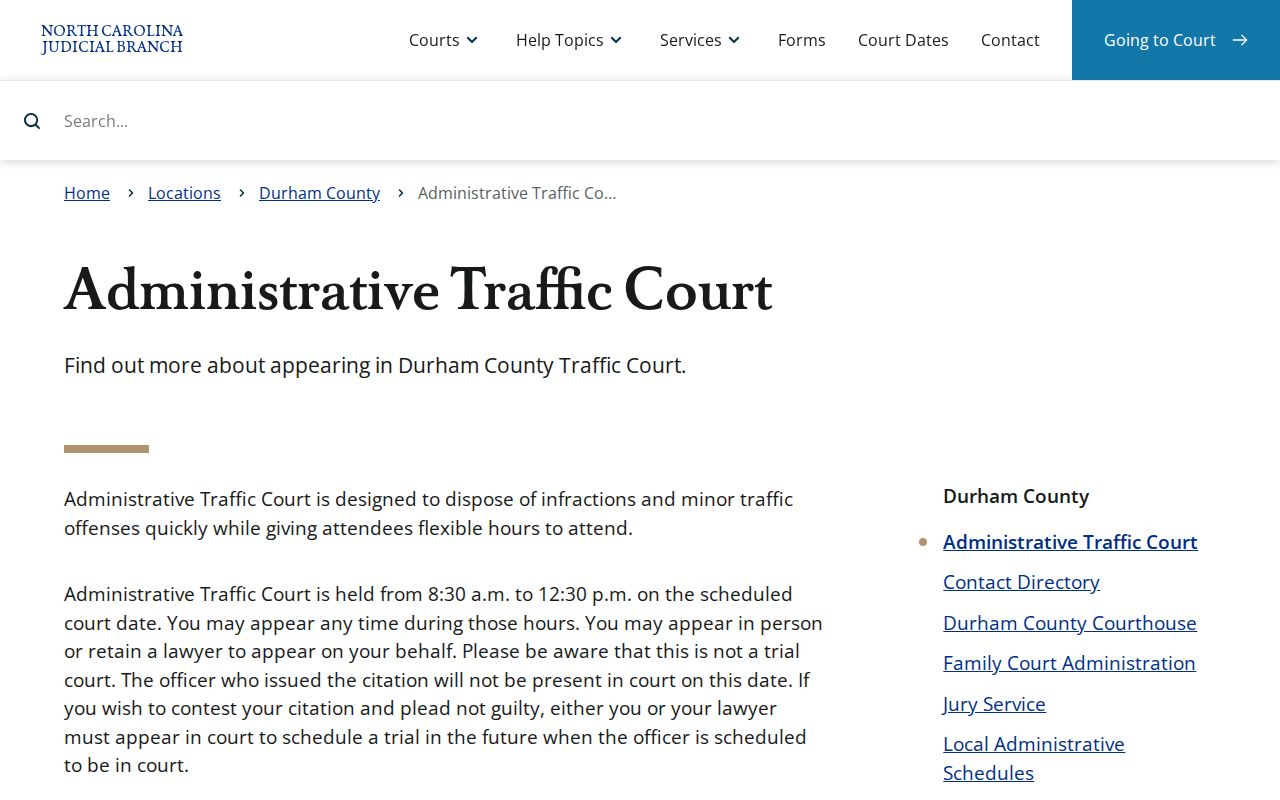
The image supports the practical distinction between an administrative appearance and the court file that records later events.
Search the Durham docket before visiting, and use the case number when speaking with the clerk. This keeps a traffic-calendar question separate from a DPD crash report, which remains with the investigating agency or its designated state channel.
Where Durham Records End Up
A Durham criminal record changes custodian as the event moves. DPD creates the city report. Detention staff create a booking record and capture identity information. A magistrate may issue process and set release conditions. The clerk then maintains the prosecution file after a charge reaches District or Superior Court. Final court outcomes are reported toward the SBI criminal-history system for matching to fingerprint-supported arrest cycles.
Record flow: Durham Police Department › Durham County Courts › North Carolina State Bureau of Investigation
The Durham flow is not instant. Recent activity may appear with police or detention before eCourts. A Durham court dismissal may appear in the docket before it is matched to the SBI cycle. If your own state record lacks a Durham disposition, obtain the certified outcome from the clerk and use the SBI correction process.
Durham Records Across City Lines
Durham’s 2024 Census estimate was 301,870, up 6.4 percent from the 2020 estimate base. That whole-city figure describes Durham, not a count of record subjects. Growth, universities, and Research Triangle Park make agency ownership less obvious. Downtown places the courthouse and detention functions close together, yet those nearby offices still maintain distinct records.
City and county record systems also share the Durham name. A caller may ask “Durham” while meaning DPD, the sheriff, the clerk, or a campus department. Start with the location and responding agency. For Chapel Hill or Raleigh edge cases, the city label alone cannot establish that a charge belongs in Durham County court.
Research Triangle Park adds another practical clue: roads, employers, campuses, and commuting patterns can place nearby events under different agencies. The record itself, not a familiar neighborhood name, should establish who responded. Once that agency is known, the Durham search can move cleanly from report to booking and court file.
Limits on Durham Police Records
North Carolina law does not make the complete investigative file public merely because police made an arrest. G.S. 132-1.4 protects criminal-investigation and intelligence records, while subsection (c) requires listed incident and arrest facts to be released. A focused Durham request can seek the time, date, place, apparent violation, arrest circumstances, weapons information, and other categories the statute makes public.
The official criminal-investigation records statute sets that boundary.
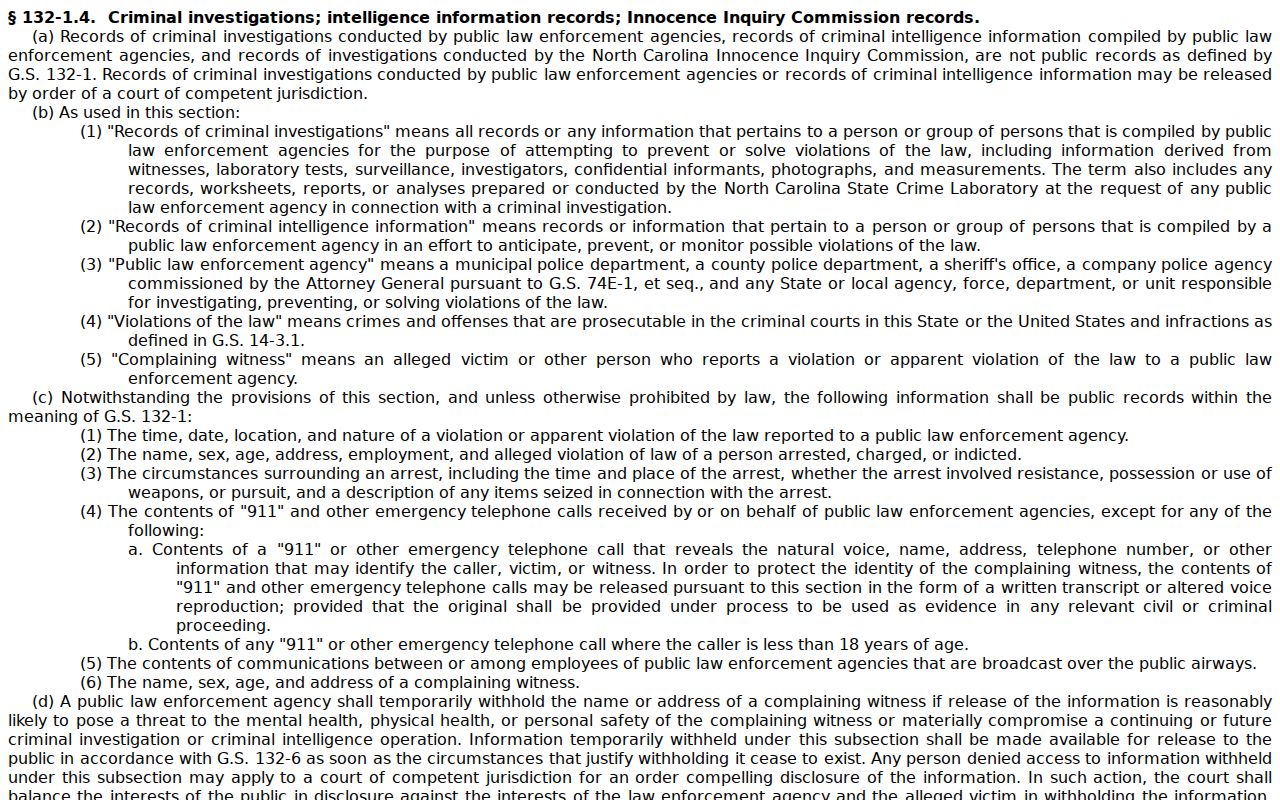
That source explains why requesting named public facts is more effective than demanding every Durham investigative note, image, or statement.
Durham body-camera recordings follow a special court procedure under G.S. 132-1.4A. Juvenile material, protected personal data, security plans, and some emergency-call contents can also be withheld or redacted.
Public Access Rules
Durham city agencies apply the North Carolina Public Records Law to records made or received in public business. People may inspect public material at reasonable times and request copies, but the custodian may charge actual cost and a special service charge for extensive technical work. A denial should identify the legal basis. Court files also carry rules for sealed, expunged, juvenile, and confidential material.
The official North Carolina Public Records Law supplies the statewide framework used by Durham custodians.
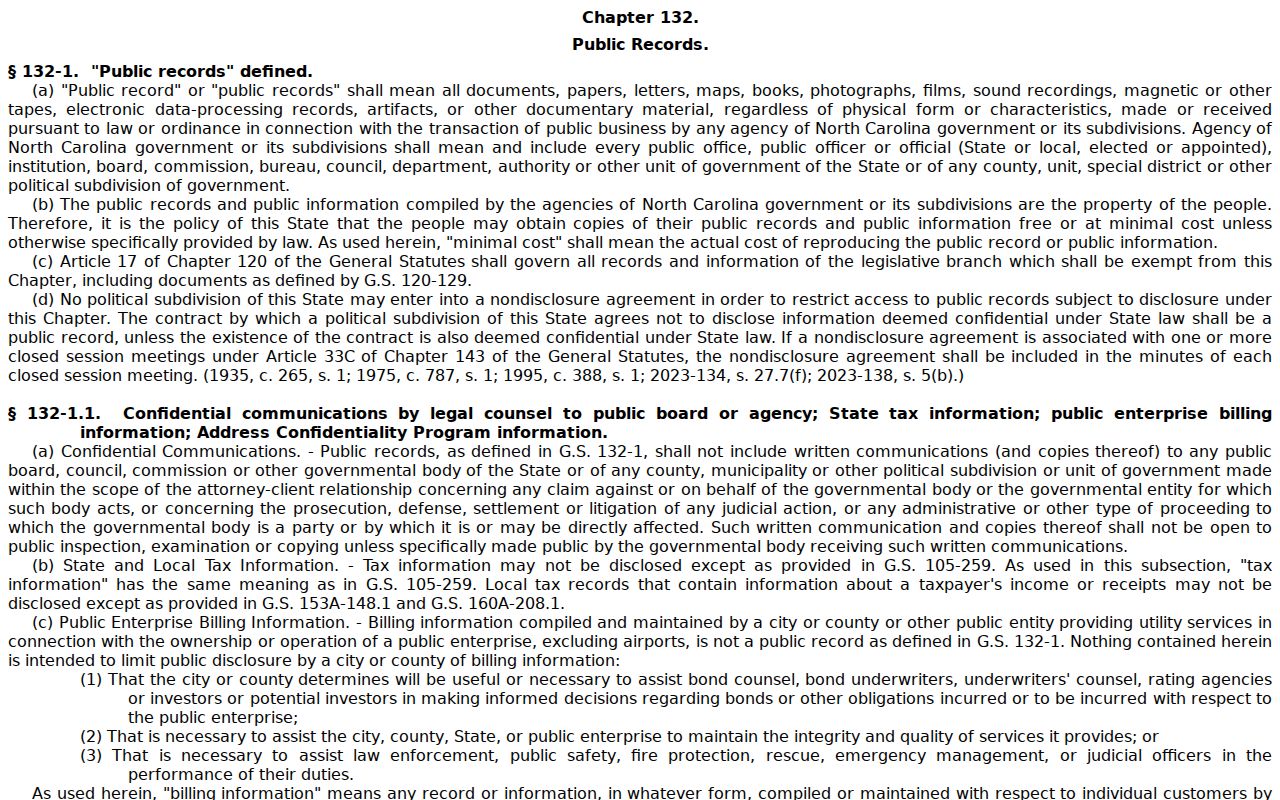
The statute image connects Durham request practice to the law that governs inspection, copies, exemptions, and agency response.
Key Statutes:
G.S. 132-1 and 132-6 define public records and require reasonable inspection and copy access.
G.S. 132-1.4 protects investigative files but makes specified arrest and incident facts public.
Article 5 of Chapter 15A governs North Carolina expunction relief and agency notice after an order.
Use the current official text and the office that holds the original Durham record. Public access does not turn a police allegation into a conviction.